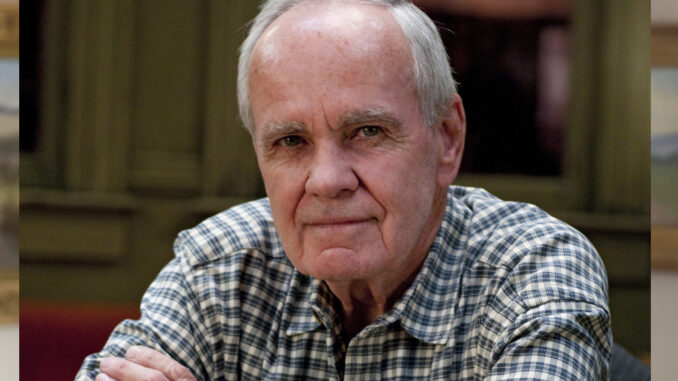
The Cormac McCarthy biography tells the story of an American novelist who worked for nearly three decades before his books found a broad audience. Born in 1933 and raised largely in Tennessee, he wrote about people living at the edges of society, then shifted his attention to the American West. His fiction could be brutally violent, yet some of his best-known pages explore how far a parent will go to protect a child.
McCarthy was a literary celebrity who rarely behaved like one. He avoided most interviews, wrote on an old manual typewriter and preferred conversations with scientists to publicity events. His books eventually earned the National Book Award and the Pulitzer Prize, while No Country for Old Men reached millions more people as an Oscar-winning film.
He died in 2023, but his story is still unfolding. Newly opened papers and a biography published in October 2026 are giving readers a clearer, sometimes uncomfortable, picture of the man behind the novels.
Cormac McCarthy Quick Facts
| Detail | Information |
|---|---|
| Birth name | Charles Joseph McCarthy Jr. |
| Known as | Cormac McCarthy |
| Born | July 20, 1933, in Providence, Rhode Island, USA |
| Died | June 13, 2023, in Santa Fe, New Mexico, USA |
| Age at death | 89 |
| Profession | Novelist, playwright and screenwriter |
| Education | Attended the University of Tennessee; did not graduate |
| Children | Two sons, Cullen and John |
| Major awards | National Book Award (1992); Pulitzer Prize for Fiction (2007) |
Early Life and Education
McCarthy was born Charles Joseph McCarthy Jr. on July 20, 1933, in Providence, Rhode Island. His family moved to Knoxville, Tennessee, where his father worked as an attorney for the Tennessee Valley Authority. The wooded hills, rivers and poorer communities around Knoxville later provided the setting for his early fiction.
He attended the University of Tennessee in the early 1950s, but left in 1953 to join the U.S. Air Force. During his four years of service, he spent time in Alaska and read widely. He returned to university in 1957, studied writing and published short stories, but left again without earning a degree. These details are recorded by the Pulitzer Prizes and in University of Tennessee archival material.
Rather than take a conventional professional route, McCarthy committed himself to writing fiction. That choice brought years of financial insecurity and relatively little public attention.
His Writing Career: From Tennessee to the Borderlands
Early novels and years of obscurity
McCarthy’s first novel, The Orchard Keeper, was published in 1965. The manuscript reached Random House editor Albert Erskine, who had also worked with William Faulkner. The novel gained critical attention, but it did not turn McCarthy into a bestselling author.
His next books, Outer Dark, Child of God and Suttree, remained rooted in the American South. Their characters included wanderers, outsiders and people damaged by poverty or violence. The language could be demanding, particularly for readers expecting straightforward dialogue and plot.
In 1981, McCarthy received a MacArthur Fellowship. He had begun turning his attention westward, and the grant helped give him more freedom to research and write. His 1985 novel Blood Meridian followed a young drifter through the violent borderlands of the nineteenth century. It became one of his most discussed books, although its graphic violence makes it difficult reading.
The novel that changed his career
All the Pretty Horses, published in 1992, brought McCarthy to a much larger readership. Its teenage protagonist, John Grady Cole, rides into Mexico in search of a way of life that is disappearing. The novel won both the National Book Award for Fiction and the National Book Critics Circle Award. The National Book Foundation confirms the 1992 win.
He continued the story’s broader borderland setting in The Crossing (1994) and Cities of the Plain (1998). Together, the three novels are known as The Border Trilogy.
No Country for Old Men and The Road
In No Country for Old Men (2005), a drug deal gone wrong leads to a chase involving a hunter, a sheriff and a ruthless killer. The Coen brothers adapted it into a 2007 film. The movie won Best Picture at the 2008 Academy Awards, along with three other Oscars, according to the Academy’s official record.
McCarthy’s next novel, The Road (2006), was different in scale. It follows a father and his young son through a devastated landscape where food and safety are scarce. Beneath its frightening setting, the book asks what love and responsibility mean when almost everything else has disappeared. It won the 2007 Pulitzer Prize for Fiction, as recorded by the Pulitzer Prize organization.
Cormac McCarthy’s Most Important Books
| Book | Year | Why it matters |
|---|---|---|
| The Orchard Keeper | 1965 | His debut novel, set in rural Tennessee |
| Suttree | 1979 | A Knoxville novel about life on society’s margins |
| Blood Meridian | 1985 | A violent historical novel set around the U.S.-Mexico border |
| All the Pretty Horses | 1992 | His commercial breakthrough and National Book Award winner |
| No Country for Old Men | 2005 | Crime novel adapted into an Oscar-winning film |
| The Road | 2006 | Father-son survival story that won the Pulitzer Prize |
| The Passenger and Stella Maris | 2022 | Two connected novels published in his final year of life |
Writing Style and Influence
McCarthy often left out quotation marks and used little punctuation around dialogue. He could switch from short, plain sentences to long descriptions of landscapes and violence. Readers sometimes compare him with Faulkner and Herman Melville, but the mix of biblical rhythms, Western settings and unsentimental dialogue became recognizably his own.
His writing rarely explains what a reader should think. In Blood Meridian, violence seems to overwhelm moral order. In The Road, the relationship between father and son offers a different kind of focus. Reading the two books together shows that his reputation for darkness does not tell the whole story.
Wife, Marriages and Children
McCarthy married three times, and all three marriages ended in divorce. His wives were Lee Holleman, Anne DeLisle and Jennifer Winkley. The University of Tennessee’s Cormac McCarthy archival description documents the marriages and identifies his two sons.
His elder son, Cullen, was born during his marriage to Lee Holleman. His younger son, John, was born during his marriage to Jennifer Winkley. McCarthy dedicated The Road to John and said in a rare 2007 interview with Oprah Winfrey that a nighttime moment watching his sleeping son helped start the idea for the novel.
McCarthy generally avoided discussing his private life publicly. Family details beyond those reliably documented should not be treated as fact.
His Interest in Science
For a novelist, McCarthy spent an unusual amount of time with scientists. He became closely involved with the Santa Fe Institute in New Mexico, where researchers study subjects such as physics, biology and complex systems. He talked with scientists, read their work and helped edit some of their writing.
The institute described him as a trustee and life fellow in its June 2023 tribute. His final novels, The Passenger and Stella Maris, explore subjects including mathematics, physics and the mind. Both appeared in 2022 after a long gap following The Road.
Death: When Did Cormac McCarthy Die?
Cormac McCarthy died on June 13, 2023, at his home in Santa Fe, New Mexico. He was 89 years old. His publisher said he died of natural causes, and his son John confirmed the news. The announcement was published by Penguin Random House.
He had published his last two novels less than a year earlier. His death closed a writing career that began with his first novel in 1965 and lasted almost six decades.
Why His Life Is Being Reexamined in 2026
McCarthy’s private life has received new attention since his death. In November 2024, Vanity Fair published an account based on interviews with Augusta Britt, who said she began a relationship with McCarthy when she was 16 and he was 42. The reporting prompted debate about his conduct and about the relationship between an author’s life and fiction. It is an account published after his death, so McCarthy could not respond to it.
In October 2025, the Wittliff Collections at Texas State University opened additional McCarthy papers to researchers. The material includes correspondence, early writing, journals and drafts that may help scholars revisit accepted accounts of his career.
On October 6, 2026, St. Martin’s Press published Cormac McCarthy: A Legacy Revisited by Tracy Daugherty. The publisher’s listing confirms its release. The biography examines the writer’s family relationships, changing career and the gap between his private life and public reputation. It adds context to a literary career whose books are already well documented.
What Is Cormac McCarthy Best Known For?
McCarthy is best known for novels that combine intense landscapes, moral conflict and unusual prose. For someone new to his work, All the Pretty Horses is an accessible entry into his Western fiction, while The Road is shorter and centers on a powerful father-son relationship. Blood Meridian is more demanding and far more graphic.
His books remain important not because every reader agrees with their outlook, but because they give readers difficult questions to think through. The opening of his archives and the new biographies are also making it easier to examine the writer himself, rather than relying only on the guarded public image he left behind.
Leave a Reply