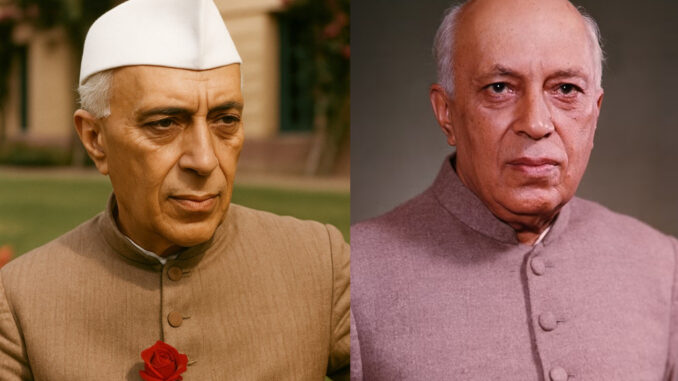
On August 15, 1947, Jawaharlal Nehru became the first prime minister of independent India. After spending years in British prisons fighting colonial rule, he now faced a much harder responsibility: leading a newly independent country divided by Partition. This Jawaharlal Nehru biography follows his transformation from a wealthy lawyer’s son into a freedom fighter, author and political leader whose decisions still shape debates about India.
Nehru served as prime minister for almost 17 years, from independence until his death in 1964. During that period, India adopted its Constitution, held nationwide democratic elections and invested heavily in industry, science and public institutions. He also helped develop a foreign policy that sought independence from the rival power blocs of the Cold War. His record, however, included difficult decisions over Kashmir, economic controls and the 1962 war with China.
Outside government, Nehru was a father who wrote letters about history and science to his daughter, Indira, who later became India’s prime minister. He also wrote several influential books while imprisoned. His birthday, November 14, is celebrated as Children’s Day in India, keeping his name familiar to generations born long after his death.
Jawaharlal Nehru Quick Facts
| Detail | Information |
|---|---|
| Full name | Jawaharlal Nehru |
| Popular names | Pandit Nehru, Chacha Nehru |
| Date of birth | November 14, 1889 |
| Date of death | May 27, 1964 |
| Age at death | 74 years |
| Birthplace | Allahabad, British India (now Prayagraj, Uttar Pradesh) |
| Place of death | New Delhi, India |
| Nationality | Indian |
| Profession | Politician, lawyer and author |
| Political party | Indian National Congress |
| Major position | First Prime Minister of India |
| Time in office | August 15, 1947 to May 27, 1964 |
| Wife | Kamala Nehru (1899–1936) |
| Daughter | Indira Gandhi (1917–1984) |
| Father | Motilal Nehru |
| Mother | Swarup Rani Nehru |
| Education | Harrow School, Trinity College Cambridge and Inner Temple, London |
| Major honour | Bharat Ratna (1955) |
Early Life and Family Background
Jawaharlal Nehru was born on November 14, 1889, in Allahabad, then part of British India. He was the son of Motilal Nehru, a successful lawyer who later became a prominent leader of the Indian National Congress.
His mother, Swarup Rani Nehru, came from a Kashmiri family. Nehru grew up with two sisters, Vijayalakshmi Pandit and Krishna Hutheesing.
The family enjoyed considerable financial comfort. They lived in large homes in Allahabad, including Anand Bhawan, which became closely associated with the independence movement.
His father’s financial position meant Nehru had access to private tutors, books and educational opportunities unavailable to most Indian children under British colonial rule.
One of his tutors, Ferdinand T. Brooks, encouraged his interest in science and reading. As a child, Nehru read fiction, history and accounts of discoveries in the natural world.
His early curiosity about science remained important throughout his life and later influenced his approach to education and economic development.
These details are documented by the Government of India’s Nehru Heritage Portal.
Jawaharlal Nehru’s Education
Nehru received most of his early education at home before travelling to England in 1905.
He attended Harrow School, an English boarding school, and then enrolled at Trinity College, University of Cambridge, in 1907.
At Cambridge, he studied natural sciences and graduated with an honours degree in 1910.
He subsequently studied law at Inner Temple in London and qualified as a barrister in 1912.
After returning to India, Nehru began working as a lawyer at the Allahabad High Court, following his father’s profession.
But he soon found himself more interested in public affairs and India’s struggle against British rule than in establishing a long-term legal career.
How Jawaharlal Nehru Entered Politics
Nehru became involved with the Indian National Congress shortly after returning from England.
He attended the Congress session at Bankipore in 1912 as a delegate, marking an early step in his political career.
His involvement deepened after meeting Mahatma Gandhi in 1916.
Gandhi’s campaigns against British colonial rule helped draw Nehru into mass political activity.
During the 1920s, Nehru participated in the Non-Cooperation Movement and became increasingly concerned with the problems facing farmers and workers.
He organised activities among cultivators in the United Provinces and supported campaigns opposing colonial policies.
His political work led to repeated arrests and imprisonment.
According to the Nehru Heritage Portal’s freedom struggle records, he spent approximately nine years in prison between 1920 and 1945.
Those periods of imprisonment interrupted his family life but also gave him time to read, reflect and write some of his best-known books.
Nehru’s Role in India’s Independence
By the late 1920s, Nehru had become one of the Indian National Congress’s prominent younger leaders.
He favoured complete independence rather than remaining within the British Empire under dominion status.
The Lahore Congress Session of 1929
In December 1929, Nehru presided over the Indian National Congress session in Lahore.
The session adopted the demand for Purna Swaraj, meaning complete independence.
The decision marked an important change in the Congress’s stated goal, strengthening the demand for an India no longer governed by Britain.
January 26, 1930, was subsequently observed by independence supporters as a day dedicated to complete independence. The date later acquired another meaning when India’s Constitution came into force on January 26, 1950.
Civil Disobedience and Quit India
Nehru continued his involvement in nationalist campaigns during the 1930s.
He participated in the Civil Disobedience Movement and was imprisoned again in 1930.
During World War II, he supported the Congress’s Quit India campaign, which demanded an end to British rule.
He was arrested in August 1942 and remained imprisoned until 1945.
Following his release, Nehru participated in negotiations over India’s political future.
In September 1946, he became vice-president of the Executive Council in the interim government, effectively heading its work as India moved toward independence.
Becoming India’s First Prime Minister in 1947
On August 15, 1947, India gained independence from British rule, and Nehru became its first prime minister.
His famous Tryst with Destiny speech, delivered to the Constituent Assembly shortly before independence, marked the occasion.
Independence also brought Partition, which created India and Pakistan as separate countries.
The division caused widespread communal violence and forced millions of people to leave their homes.
Nehru’s government faced the immediate problems of refugee resettlement, restoring public order and building institutions for a newly independent country.
Working alongside other leaders, including Sardar Vallabhbhai Patel and B. R. Ambedkar, Nehru helped guide India’s transition from colonial administration to constitutional government.
He remained prime minister following the country’s first general election in 1951–1952 and subsequent elections in 1957 and 1962.
India’s official prime ministerial biography confirms that he served continuously until May 27, 1964.
Major Achievements as Prime Minister
Nehru’s government pursued development through public investment, democratic institutions and international cooperation.
His achievements are best understood as part of the work of successive governments, ministers, scientists and public institutions, rather than the accomplishments of one person alone.
Strengthening Parliamentary Democracy
India’s Constitution came into force on January 26, 1950, making the country a republic.
Nehru’s administration participated in establishing the institutions needed to operate the constitutional system.
India held its first nationwide general election in 1951–1952, with voting rights extending to adults regardless of wealth, education or social background.
The election involved enormous administrative challenges, including registering voters and organising polling across a large, diverse population.
The Indian Express history of India’s first general election explains how the country carried out that process.
Nehru also supported a secular political framework in which the state would not identify itself exclusively with one religious community.
Industrial and Economic Development
India inherited widespread poverty, low industrial production and major infrastructure needs after independence.
Nehru’s government adopted a mixed economic model that combined private enterprise with substantial government ownership, investment and regulation.
The Planning Commission was established in 1950, and the First Five-Year Plan began in 1951.
Government investment supported projects involving agriculture, transport, electricity, heavy industry and irrigation.
Large dams and industrial plants became prominent symbols of the development strategy.
The approach created important infrastructure and industrial capacity. However, economists and historians have also examined its heavy dependence on state controls and the restrictions placed on private economic activity.
Historian Nikhil Menon’s Planning Democracy explains how economic planning became central to the early Indian government’s development strategy.
Science, Education and Research
Nehru believed that science and technical education were important for improving living conditions and developing a modern economy.
During his time in office, India expanded institutions for engineering, medical education and scientific research.
The Indian Institute of Technology at Kharagpur began operating in 1951, while the All India Institute of Medical Sciences in New Delhi was established in 1956.
These institutions developed through the work of multiple public officials, educators and researchers, with support from the national government.
His administration also supported India’s early atomic energy programme and scientific research infrastructure.
Jawaharlal Nehru’s Foreign Policy
During the Cold War, much of international politics was divided between the United States and the Soviet Union.
Nehru favoured non-alignment, meaning India would avoid joining military alliances controlled by either major power bloc.
He believed this would allow India to make foreign policy decisions according to its own interests.
Nehru participated in the development of the Non-Aligned Movement, whose first summit was held in Belgrade in 1961.
Other prominent leaders associated with the movement included Yugoslavia’s Josip Broz Tito and Egypt’s Gamal Abdel Nasser.
Nehru explained his position in a July 1962 letter preserved in the Nehru Archive. He argued that military alliances could reduce a country’s freedom to decide its own international policy.
Non-alignment did not mean India avoided all relationships with major powers. It maintained diplomatic and economic ties with countries on both sides of the Cold War.
Kashmir, China and Criticism of Nehru’s Policies
Nehru’s political record remains the subject of historical debate, particularly over Kashmir, India’s economic direction and relations with China.
The Kashmir Dispute
Kashmir became a major dispute between India and Pakistan during Partition in 1947.
After armed conflict began, India brought the issue before the United Nations in 1948.
Nehru maintained that Jammu and Kashmir belonged to India following the state’s accession, while Pakistan disputed India’s position.
His handling of the conflict, including the decision to involve the United Nations and subsequent disagreements over political arrangements, remains controversial.
Critics argue that his decisions complicated efforts to settle the dispute. Other historical accounts stress the wider circumstances of Partition, military conflict and competing territorial claims.
Nehru discussed India’s position in a June 1962 press conference preserved in his collected records.
The Sino-Indian War of 1962
India and China initially pursued diplomatic cooperation after India gained independence and the People’s Republic of China was established.
However, disagreements over their Himalayan border became increasingly serious.
In October 1962, fighting broke out between Indian and Chinese forces.
India suffered major military setbacks before China declared a unilateral ceasefire in November.
The conflict damaged confidence in Nehru’s foreign policy and raised questions about India’s military preparation.
Critics have argued that Nehru’s government underestimated the possibility of a serious conflict with China.
Historical analysis also examines military leadership, intelligence assessments, geography and diplomatic failures when explaining the outcome.
A 2026 scholarly review in India Review describes how disagreements over Kashmir, China and other policies remain central to assessments of Nehru’s record.
Who Was Jawaharlal Nehru’s Wife?
Jawaharlal Nehru married Kamala Kaul on February 8, 1916, in Delhi.
Kamala came from a Kashmiri family and was 16 years old at the time of the marriage.
The couple initially faced difficulties adjusting to differences in their family backgrounds and lifestyles.
Nehru’s growing involvement in politics also meant he spent long periods away from home.
Kamala eventually became active in India’s freedom movement herself, participating in nationalist campaigns.
She later developed tuberculosis and received treatment in India and Europe.
Kamala Nehru died on February 28, 1936, in Lausanne, Switzerland. Nehru was with her during her final illness.
The Government of India’s official account of Nehru’s marriage documents their relationship, Kamala’s political involvement and her illness.
How Many Children Did Jawaharlal Nehru Have?
Jawaharlal and Kamala Nehru welcomed their daughter, Indira Priyadarshini Nehru, on November 19, 1917.
Kamala also gave birth to a premature baby boy who died. Indira was the couple’s only surviving child.
Indira later married Feroze Gandhi in 1942 and became known publicly as Indira Gandhi.
She served as India’s prime minister from 1966 to 1977 and again from 1980 until her assassination in 1984.
Nehru’s family connections extended into another generation of Indian politics.
His grandson Rajiv Gandhi became prime minister in 1984, following Indira Gandhi’s death.
These family relationships are documented in the Nehru Heritage Portal family records.
Jawaharlal Nehru’s Famous Books
Nehru was an active writer whose books explored Indian history, international affairs, politics and his own experiences.
Some of his most important works were written during periods of imprisonment under British rule.
| Book | First published | Main subject |
|---|---|---|
| Letters from a Father to His Daughter | 1929 | Letters explaining nature, history and civilisation to Indira |
| Glimpses of World History | 1934 | World history presented through letters |
| An Autobiography | 1936 | His life, political beliefs and India’s freedom movement |
| The Discovery of India | 1946 | Indian history, philosophy, culture and national identity |
The Discovery of India
The Discovery of India is among Nehru’s best-known books.
He wrote it while imprisoned at Ahmednagar Fort during World War II.
The book examines India’s history, religion, philosophy and cultural traditions, exploring how different influences shaped the country.
It was first published in 1946 and later inspired the television series Bharat Ek Khoj.
Penguin Random House India’s book profile confirms its publication history and the circumstances in which it was written.
Letters from a Father to His Daughter
In 1928, Nehru wrote a series of letters to his young daughter Indira, who was staying in Mussoorie while he was in Allahabad.
The letters explained subjects such as the formation of the Earth, the development of human society and early civilisations.
They were published together in 1929.
The collection provides an unusually personal view of Nehru as a father and educator.
Readers can find information about the work on the Nehru Heritage Portal.
Jawaharlal Nehru’s Awards and Honours
In 1955, Jawaharlal Nehru received the Bharat Ratna, India’s highest civilian honour.
The award recognised his public service and contribution to the country.
The Government of India’s official notification dated July 15, 1955 records the award.
Nehru was also remembered internationally for his role in the independence movement and his participation in non-aligned diplomacy.
Why Is Nehru’s Birthday Celebrated as Children’s Day?
India celebrates Children’s Day on November 14, the anniversary of Nehru’s birth.
He was widely known as Chacha Nehru, meaning Uncle Nehru, a nickname associated with his public affection for children.
Following his death in 1964, India adopted his birthday as the date for its national Children’s Day observance.
Schools often mark the occasion with educational programmes, performances and activities focusing on children’s welfare.
India’s public broadcaster DD News explains the history of the celebration.
When and How Did Jawaharlal Nehru Die?
Jawaharlal Nehru died on May 27, 1964, in New Delhi, aged 74.
His health had declined during his final months, and he suffered a stroke earlier in 1964. He died while still serving as prime minister.
His death ended almost 17 years of continuous leadership following India’s independence.
Nehru was cremated on May 28, 1964, on the banks of the Yamuna in Delhi, at a memorial site now known as Shanti Van.
His official residence at Teen Murti House was later converted into a memorial museum and library.
Details of his death and memorial are preserved in India’s Nehru Heritage Portal.
Jawaharlal Nehru’s Legacy in Modern India
Jawaharlal Nehru remains an important figure in the history of independent India, both because of his long period in office and because many of his policies influenced the country’s later development.
His government supported parliamentary democracy, economic planning, public institutions and a foreign policy that avoided formal alignment with the major Cold War military blocs.
Those policies produced results that historians continue to examine. India’s early democratic elections and public institutions are frequently discussed as major achievements of the period, while debates over economic regulation, Kashmir and the 1962 war remain unsettled.
His legacy also reaches beyond government. His books remain available, his family played a major role in later Indian politics, and his birthday continues to be observed nationally.
For readers studying India’s early decades after independence, Nehru’s life provides a direct way to understand the country’s political choices, institutional development and unresolved historical questions.
Leave a Reply